Good point: http://valerieaurora.wordpress.com/2010/01/11/great-benchmarking-advice/
That's very scientific, for sure. I more or less agree. Although, I probably don't follow this (look at previous posts).
Tuesday, January 12, 2010

Wednesday, December 02, 2009
So those previous benchmarks weren't benchmarks:
The first is the 1.2Ghz ARM5 processor from Marvell (the one in the Sheevaplug)
Now the Geode...
AMD Athlon 64 X2...
Going by this the Marvell ARM board (essentially the Sheevaplug with more NIC's) has no floating point performance (soft-float). Still in integer performance it does alright (more than 2 times the Geode's performance).
Unfortunately my Sheevaplug is slower than other people's for some reason. And it would seem that yes, the Core2Duo does kick ass.
The first is the 1.2Ghz ARM5 processor from Marvell (the one in the Sheevaplug)
# nbench

BYTEmark* Native Mode Benchmark ver. 2 (10/95)
Index-split by Andrew D. Balsa (11/97)
Linux/Unix* port by Uwe F. Mayer (12/96,11/97)

TEST                : Iterations/sec.  : Old Index   : New Index
                    :                  : Pentium 90* : AMD K6/233*
--------------------:------------------:-------------:------------
NUMERIC SORT        :          354.24  :       9.08  :       2.98
STRING SORT         :          33.613  :      15.02  :       2.32
BITFIELD            :      8.4763e+07  :      14.54  :       3.04
FP EMULATION        :          38.723  :      18.58  :       4.29
FOURIER             :          362.87  :       0.41  :       0.23
ASSIGNMENT          :          4.6711  :      17.77  :       4.61
IDEA                :          1201.9  :      18.38  :       5.46
HUFFMAN             :          462.25  :      12.82  :       4.09
NEURAL NET          :         0.51582  :       0.83  :       0.35
LU DECOMPOSITION    :          16.481  :       0.85  :       0.62
==========================ORIGINAL BYTEMARK RESULTS==========================
INTEGER INDEX       : 14.784
FLOATING-POINT INDEX: 0.663
Baseline (MSDOS*)   : Pentium* 90, 256 KB L2-cache, Watcom* compiler 10.0
==============================LINUX DATA BELOW===============================
CPU                 :
L2 Cache            :
OS                  : Linux 2.6.31-gentoo-r6
C compiler          : armv5tel-softfloat-linux-gnueabi-gcc
libc                :
MEMORY INDEX        : 3.193
INTEGER INDEX       : 4.112
FLOATING-POINT INDEX: 0.368
Baseline (LINUX)    : AMD K6/233*, 512 KB L2-cache, gcc 2.7.2.3, libc-5.4.38
* Trademarks are property of their respective holder.
Now the Geode...
$ nbench

BYTEmark* Native Mode Benchmark ver. 2 (10/95)
Index-split by Andrew D. Balsa (11/97)
Linux/Unix* port by Uwe F. Mayer (12/96,11/97)

TEST                : Iterations/sec.  : Old Index   : New Index
                    :                  : Pentium 90* : AMD K6/233*
--------------------:------------------:-------------:------------
NUMERIC SORT        :          124.28  :       3.19  :       1.05
STRING SORT         :          15.581  :       6.96  :       1.08
BITFIELD            :      4.4277e+07  :       7.60  :       1.59
FP EMULATION        :          13.392  :       6.43  :       1.48
FOURIER             :          1999.4  :       2.27  :       1.28
ASSIGNMENT          :          3.3664  :      12.81  :       3.32
IDEA                :          519.83  :       7.95  :       2.36
HUFFMAN             :          215.18  :       5.97  :       1.91
NEURAL NET          :          1.6729  :       2.69  :       1.13
LU DECOMPOSITION    :          71.611  :       3.71  :       2.68
==========================ORIGINAL BYTEMARK RESULTS==========================
INTEGER INDEX       : 6.779
FLOATING-POINT INDEX: 2.830
Baseline (MSDOS*)   : Pentium* 90, 256 KB L2-cache, Watcom* compiler 10.0
==============================LINUX DATA BELOW===============================
CPU                 : AuthenticAMD Geode(TM) Integrated Processor by AMD PCS 498MHz
L2 Cache            : 128 KB
OS                  : Linux 2.6.32-rc8
C compiler          : i586-pc-linux-gnu-gcc
libc                :
MEMORY INDEX        : 1.784
INTEGER INDEX       : 1.625
FLOATING-POINT INDEX: 1.570
Baseline (LINUX)    : AMD K6/233*, 512 KB L2-cache, gcc 2.7.2.3, libc-5.4.38
* Trademarks are property of their respective holder.
AMD Athlon 64 X2...
# nbench

BYTEmark* Native Mode Benchmark ver. 2 (10/95)
Index-split by Andrew D. Balsa (11/97)
Linux/Unix* port by Uwe F. Mayer (12/96,11/97)

TEST                : Iterations/sec.  : Old Index   : New Index
                    :                  : Pentium 90* : AMD K6/233*
--------------------:------------------:-------------:------------
NUMERIC SORT        :          719.36  :      18.45  :       6.06
STRING SORT         :          119.58  :      53.43  :       8.27
BITFIELD            :      3.2184e+08  :      55.21  :      11.53
FP EMULATION        :          84.806  :      40.69  :       9.39
FOURIER             :           11684  :      13.29  :       7.46
ASSIGNMENT          :          15.326  :      58.32  :      15.13
IDEA                :          3096.3  :      47.36  :      14.06
HUFFMAN             :            1190  :      33.00  :      10.54
NEURAL NET          :          24.162  :      38.81  :      16.33
LU DECOMPOSITION    :          850.16  :      44.04  :      31.80
==========================ORIGINAL BYTEMARK RESULTS==========================
INTEGER INDEX       : 41.210
FLOATING-POINT INDEX: 28.320
Baseline (MSDOS*)   : Pentium* 90, 256 KB L2-cache, Watcom* compiler 10.0
==============================LINUX DATA BELOW===============================
CPU                 : Dual AuthenticAMD AMD Athlon(tm) 64 X2 Dual Core Processor 6000+ 2993MHz
L2 Cache            : 1024 KB
OS                  : Linux 2.6.31
C compiler          : x86_64-pc-linux-gnu-gcc
libc                :
MEMORY INDEX        : 11.299
INTEGER INDEX       : 9.582
FLOATING-POINT INDEX: 15.707
Baseline (LINUX)    : AMD K6/233*, 512 KB L2-cache, gcc 2.7.2.3, libc-5.4.38
* Trademarks are property of their respective holder.
Going by this the Marvell ARM board (essentially the Sheevaplug with more NIC's) has no floating point performance (soft-float). Still in integer performance it does alright (more than 2 times the Geode's performance).
Unfortunately my Sheevaplug is slower than other people's for some reason. And it would seem that yes, the Core2Duo does kick ass.
More basic benchmarks (stress running -c - which apparently computes sqrt() at some rate):
The Marvell board has a 1200Mhz X-Scale (ARM5) versus the AMD Geode (x86) 500Mhz. With about the same amount of RAM (some more things are running on the Geode device) the ARM board appears to win. But not by much; and this is supposedly a fast ARM board. I'm very curious about a Cortex-A8 to see how that does, but I don't have a beagleboard to test on.
Oh, but wait...
So it just goes as fast as it can. WTF is the point of stress again?
# stress -t 30s -c 8 -m 1 && cat /proc/loadavg
stress: info: [6975] dispatching hogs: 8 cpu, 0 io, 1 vm, 0 hdd
stress: info: [6975] successful run completed in 30s
3.64 1.23 0.53 1/47 6985
# cat /proc/cpuinfo
Processor       : Feroceon 88FR131 rev 1 (v5l)
BogoMIPS        : 1192.75
Features        : swp half thumb fastmult edsp
CPU implementer : 0x56
CPU architecture: 5TE
CPU variant     : 0x2
CPU part        : 0x131
CPU revision    : 1

Hardware        : Marvell RD-88F6281 Reference Board
Revision        : 0000
Serial          : 0000000000000000
$ stress -t 30s -c 8 -m 1 && cat /proc/loadavg
stress: info: [10077] dispatching hogs: 8 cpu, 0 io, 1 vm, 0 hdd
stress: info: [10077] successful run completed in 30s
3.78 1.28 0.85 1/126 10087
$ cat /proc/cpuinfo
processor       : 0
vendor_id       : AuthenticAMD
cpu family      : 5
model           : 10
model name      : Geode(TM) Integrated Processor by AMD PCS
stepping        : 2
cpu MHz         : 498.091
cache size      : 128 KB
fdiv_bug        : no
hlt_bug         : no
f00f_bug        : no
coma_bug        : no
fpu             : yes
fpu_exception   : yes
cpuid level     : 1
wp              : yes
flags           : fpu de pse tsc msr cx8 sep pge cmov clflush mmx mmxext 3dnowext 3dnow
bogomips        : 996.18
clflush size    : 32
cache_alignment : 32
address sizes   : 32 bits physical, 32 bits virtual
power management:
The Marvell board has a 1200Mhz X-Scale (ARM5) versus the AMD Geode (x86) 500Mhz. With about the same amount of RAM (some more things are running on the Geode device) the ARM board appears to win. But not by much; and this is supposedly a fast ARM board. I'm very curious about a Cortex-A8 to see how that does, but I don't have a beagleboard to test on.
Oh, but wait...
$ stress -t 30s -c 8 -m 1 && cat /proc/loadavg
stress: info: [20281] dispatching hogs: 8 cpu, 0 io, 1 vm, 0 hdd
stress: info: [20281] successful run completed in 30s
4.00 0.99 0.32 1/231 20291
$ cat /proc/cpuinfo
processor       : 0
vendor_id       : AuthenticAMD
cpu family      : 15
model           : 67
model name      : AMD Athlon(tm) 64 X2 Dual Core Processor 6000+
stepping        : 3
cpu MHz         : 2992.907
cache size      : 1024 KB
physical id     : 0
siblings        : 2
core id         : 0
cpu cores       : 2
apicid          : 0
initial apicid  : 0
fpu             : yes
fpu_exception   : yes
cpuid level     : 1
wp              : yes
flags           : fpu vme de pse tsc msr pae mce cx8 apic sep mtrr pge mca cmov
pat pse36 clflush mmx fxsr sse sse2 ht syscall nx mmxext fxsr_opt rdtscp lm 3dno
wext 3dnow rep_good extd_apicid pni cx16 lahf_lm cmp_legacy svm extapic cr8_lega
cy
bogomips        : 5985.81
TLB size        : 1024 4K pages
clflush size    : 64
cache_alignment : 64
address sizes   : 40 bits physical, 48 bits virtual
power management: ts fid vid ttp tm stc

processor       : 1
vendor_id       : AuthenticAMD
cpu family      : 15
model           : 67
model name      : AMD Athlon(tm) 64 X2 Dual Core Processor 6000+
stepping        : 3
cpu MHz         : 2992.907
cache size      : 1024 KB
physical id     : 0
siblings        : 2
core id         : 1
cpu cores       : 2
apicid          : 1
initial apicid  : 1
fpu             : yes
fpu_exception   : yes
cpuid level     : 1
wp              : yes
flags           : fpu vme de pse tsc msr pae mce cx8 apic sep mtrr pge mca cmov
pat pse36 clflush mmx fxsr sse sse2 ht syscall nx mmxext fxsr_opt rdtscp lm 3dno
wext 3dnow rep_good extd_apicid pni cx16 lahf_lm cmp_legacy svm extapic cr8_lega
cy
bogomips        : 5985.51
TLB size        : 1024 4K pages
clflush size    : 64
cache_alignment : 64
address sizes   : 40 bits physical, 48 bits virtual
power management: ts fid vid ttp tm stc
So it just goes as fast as it can. WTF is the point of stress again?
Sunday, October 25, 2009
More on the Radeon (after upgrade from 9.04 to 9.10):
Now I'm really curious how actual games perform. This certainly hints at quite an improvement over the ~3K I was getting before.
bryan@baal:~$ glxgears
7808 frames in 5.0 seconds
7736 frames in 5.0 seconds
7703 frames in 5.0 seconds
7809 frames in 5.0 seconds
XIO:  fatal IO error 11 (Resource temporarily unavailable) on X server ":0.0"
      after 38 requests (38 known processed) with 0 events remaining.
bryan@baal:~$ lspci | grep ATI
01:00.0 VGA compatible controller: ATI Technologies Inc RV730 PRO [Radeon HD 4650]
01:00.1 Audio device: ATI Technologies Inc R700 Audio Device [Radeon HD 4000 Series]
Now I'm really curious how actual games perform. This certainly hints at quite an improvement over the ~3K I was getting before.
Wednesday, September 30, 2009
UT2004 benchmarks:
Here are results over the last year and 9 months or so:
It goes up and down, but considering how old this game (and that it performs much better on windows) is somewhat sad, but not surprising.
That last instance was run several minutes ago:
I think people were getting some 40 FPS in windows....
$ cat /opt/ut2004-demo/Benchmark/benchmark.sh
#!/bin/sh
ut2004-demo dm-rankin?spectatoronly=1?numbots=12?quickstart=1?attractcam=1 -benchmark -seconds=77 -ini=default.ini -exec=/opt/ut2004-demo/Benchmark/Stuff/botmatchexec.txt
Here are results over the last year and 9 months or so:
2.736331 / 14.235601 / inf fps -- Score = 13.679287        rand[276381637]
5.503653 / 11.982956 / 34.976410 fps -- Score = 11.987910        rand[1886997259]
5.563165 / 12.212557 / 45.396217 fps -- Score = 12.217196        rand[1886997259]
5.556774 / 12.213729 / 46.879482 fps -- Score = 12.218822        rand[1886997259]
3.780525 / 204.517151 / inf fps -- Score = 61.584534        rand[1605499383]
5.914872 / 13.538128 / 115.044312 fps -- Score = 13.543859        rand[1886997259]
5.240792 / 28.211584 / inf fps -- Score = 26.802221        rand[1357638259]
5.196166 / 22.054844 / 60.286556 fps -- Score = 22.120491        rand[1886997259]
7.092757 / 25.348576 / 76.011848 fps -- Score = 25.362152        rand[1886997259]
5.720313 / 21.504700 / 61.338535 fps -- Score = 21.514923        rand[1886997259]
9.163403 / 24.096804 / 88.282417 fps -- Score = 24.170898        rand[1886997259]
4.439383 / 24.573044 / 76.100990 fps -- Score = 24.603319        rand[1886997259]
5.927572 / 27.762682 / 130.561325 fps -- Score = 27.756296        rand[1886997259]
4.238309 / 27.693068 / 95.542274 fps -- Score = 27.792650        rand[1886997259]
8.512435 / 28.529356 / 69.447021 fps -- Score = 28.553085        rand[1886997259]
4.627872 / 30.571907 / 110.623741 fps -- Score = 30.584023        rand[1886997259]
9.365571 / 21.006798 / 141.206314 fps -- Score = 21.015017        rand[1886997259]
6.343858 / 22.841759 / 79.750206 fps -- Score = 22.853823        rand[1886997259]
6.288816 / 22.901237 / 79.940460 fps -- Score = 22.911160        rand[1886997259]
6.933957 / 26.870264 / 115.506584 fps -- Score = 26.882593        rand[1886997259]
4.404226 / 26.891077 / 113.770134 fps -- Score = 26.900879        rand[1886997259]
7.666574 / 27.085035 / 90.499039 fps -- Score = 27.101841        rand[1886997259]
4.793906 / 27.111494 / 113.976692 fps -- Score = 27.120817        rand[1886997259]
5.426033 / 26.120008 / 110.599205 fps -- Score = 26.131107        rand[1886997259]
6.902118 / 25.060440 / 108.251572 fps -- Score = 25.068457        rand[1886997259]
8.680158 / 25.102127 / 113.842644 fps -- Score = 25.109219        rand[1886997259]
It goes up and down, but considering how old this game (and that it performs much better on windows) is somewhat sad, but not surprising.
That last instance was run several minutes ago:
$ cat Results/avgfps-2009-09-30-22-46-48.log UT2004 Build UT2004_Build_[2004-09-21_19.13]
x86-64 Linux
 Unknown processor @ 2394 MHz
Mesa DRI Intel(R) 965GM GEM 20090712 2009Q2 RC3

dm-rankin?spectatoronly=1?numbots=12?quickstart=1?attractcam=1 -benchmark -seconds=77 -exitafterdemo -exec=/opt/ut2004-demo/Benchmark/Stuff/botmatchexec.txt

8.680158 / 25.102127 / 113.842644 fps         rand[1886997259]
Score = 25.109219
I think people were getting some 40 FPS in windows....
Sunday, September 27, 2009
Related to the previous post:
The Radeon plays Half-Life Episode 2 with low/medium detail at playable framerates (through WINE). But even this is a slow card compared to the higher end cards (and especially Nvidia cards in Linux).
bryan@baal:~$ glxgears
Running synchronized to the vertical refresh.  The framerate should be
approximately 1/195213 the monitor refresh rate.
15438 frames in 5.0 seconds = 3087.536 FPS
15345 frames in 5.0 seconds = 3068.929 FPS
15339 frames in 5.0 seconds = 3067.797 FPS
XIO:  fatal IO error 11 (Resource temporarily unavailable) on X server ":0.0"
      after 50 requests (49 known processed) with 0 events remaining.
bryan@baal:~$ lspci | grep ATI
01:00.0 VGA compatible controller: ATI Technologies Inc RV730 PRO [Radeon HD 4650]
01:00.1 Audio device: ATI Technologies Inc R700 Audio Device [Radeon HD 4000 Series]
The Radeon plays Half-Life Episode 2 with low/medium detail at playable framerates (through WINE). But even this is a slow card compared to the higher end cards (and especially Nvidia cards in Linux).
Friday, September 25, 2009
Oh, and with the VIA Nano I can get ~230 fps for glxgears in Ubuntu Karmic Alpha 6.
W00t!
Yeah, somehow I'm not surprised "VIA Chrome9 HC3 Integrated Graphics" aren't very good. As a comparison my crappy G965 (X3100) Thinkpad gets around ~1000 to ~1100 depending on what crazy crap they changed (or when it completely breaks and drops to 100).
I've been told glxgears is a bad benchmark, but it is a good ballpark (because it does seem to relate with general card performance pretty well when fancy things like shaders/glsl stuff isn't involved. Kind of a raw power benchmark.
After all, all glxgears does is render 3 gears made of solid color polygons via display lists. So that is the performance you are benchmarking (not cooler VBO's .... or other cool things like "textures" - you may have heard of them).
I wonder if there is any KMS stuff in the pipe for the Chrome9? Or if it's even worth while...
W00t!
Yeah, somehow I'm not surprised "VIA Chrome9 HC3 Integrated Graphics" aren't very good. As a comparison my crappy G965 (X3100) Thinkpad gets around ~1000 to ~1100 depending on what crazy crap they changed (or when it completely breaks and drops to 100).
I've been told glxgears is a bad benchmark, but it is a good ballpark (because it does seem to relate with general card performance pretty well when fancy things like shaders/glsl stuff isn't involved. Kind of a raw power benchmark.
After all, all glxgears does is render 3 gears made of solid color polygons via display lists. So that is the performance you are benchmarking (not cooler VBO's .... or other cool things like "textures" - you may have heard of them).
I wonder if there is any KMS stuff in the pipe for the Chrome9? Or if it's even worth while...
I finally got my stupid VIA Nano (U2300) working, it was as simple as this:
idle=poll
(added to kernel boot param - apparently idle=halt should also work).
With this both Fedora 11, and Ubuntu 9.10 Alpha 6 work. And fedora boots up quicker :)
The idle parameter has a number of values it can take, and they appear to boot the box in different fashions (halt is "cooler", or so I read on a forum - the kernel docs make it look like the mid-range C-states are not used, which is rather bizarre - a sort of all or nothing approach to CPU power management?).
From /usr/src/linux/Documentation/kernel-parameters.txt (this includes X86_64 as well):
Needless to say, I'll stay with idle=poll. Apparently this is need for all Linux kernels 2.6.24 and above.
Board found here (and elsewhere, probably):
http://www.logicsupply.com/products/nf76_n1gl_lf
idle=poll
(added to kernel boot param - apparently idle=halt should also work).
With this both Fedora 11, and Ubuntu 9.10 Alpha 6 work. And fedora boots up quicker :)
The idle parameter has a number of values it can take, and they appear to boot the box in different fashions (halt is "cooler", or so I read on a forum - the kernel docs make it look like the mid-range C-states are not used, which is rather bizarre - a sort of all or nothing approach to CPU power management?).
From /usr/src/linux/Documentation/kernel-parameters.txt (this includes X86_64 as well):
  idle=   [X86]
      Format: idle=poll, idle=mwait, idle=halt, idle=nomwait
      Poll forces a polling idle loop that can slightly
      improve the performance of waking up a idle CPU, but
      will use a lot of power and make the system run hot.
      Not recommended.
      idle=mwait: On systems which support MONITOR/MWAIT but
      the kernel chose to not use it because it doesn't save
      as much power as a normal idle loop, use the
      MONITOR/MWAIT idle loop anyways. Performance should be
      the same as idle=poll.
      idle=halt: Halt is forced to be used for CPU idle.
      In such case C2/C3 won't be used again.
      idle=nomwait: Disable mwait for CPU C-states
Needless to say, I'll stay with idle=poll. Apparently this is need for all Linux kernels 2.6.24 and above.
Board found here (and elsewhere, probably):
http://www.logicsupply.com/products/nf76_n1gl_lf
Thursday, August 13, 2009
The Fastest Defeat In Chess
The big name for us in the world of chess is Gibaud, a French chess
master.
In Paris during 1924 he was beaten after only four moves by a
Monsieur Lazard. Happily for posterity, the moves are recorded and so
chess enthusiasts may reconstruct this magnificent collapse in the comfort
of their own homes.
Lazard was black and Gibaud white:
1: P-Q4, Kt-KB3
2: Kt-Q2, P-K4
3: PxP, Kt-Kt5
4: P-K6, Kt-K6
White then resigns on realizing that a fifth move would involve
either a Q-KR5 check or the loss of his queen.
-- Stephen Pile, "The Book of Heroic Failures"
The big name for us in the world of chess is Gibaud, a French chess
master.
In Paris during 1924 he was beaten after only four moves by a
Monsieur Lazard. Happily for posterity, the moves are recorded and so
chess enthusiasts may reconstruct this magnificent collapse in the comfort
of their own homes.
Lazard was black and Gibaud white:
1: P-Q4, Kt-KB3
2: Kt-Q2, P-K4
3: PxP, Kt-Kt5
4: P-K6, Kt-K6
White then resigns on realizing that a fifth move would involve
either a Q-KR5 check or the loss of his queen.
-- Stephen Pile, "The Book of Heroic Failures"
Thursday, May 14, 2009
Future Stock
"Back in the 1980's I was the toast of Wall Street. I was having whiskey with Boesky and cookies with Milken. But then, I was diagnosed with terminal boneitis."
I love this line.
"Back in the 1980's I was the toast of Wall Street. I was having whiskey with Boesky and cookies with Milken. But then, I was diagnosed with terminal boneitis."
I love this line.
Sunday, March 29, 2009
The Banks Were Profitable In January And February Thanks To... AIG
Yay, now I can sleep better knowing that we are in good hands.
The Quiet Coup
Even more push for nationalization... now!
Yay, now I can sleep better knowing that we are in good hands.
The Quiet Coup
Even more push for nationalization... now!
Monday, March 16, 2009
Toyota: Moving Forward
http://news.bbc.co.uk/2/hi/africa/7932316.stm
The new marketing paradigm: product placement in war. To me this is a hilarious idea. But that's probably just me.
http://news.bbc.co.uk/2/hi/africa/7932316.stm
The new marketing paradigm: product placement in war. To me this is a hilarious idea. But that's probably just me.
Monday, March 09, 2009
Heres a link to the Vanity Fair article:
http://www.vanityfair.com/politics/features/2009/04/iceland200904
Oh theres more...
There are, of course, a few jobs in Iceland that any refined, educated person might like to do. Certifying the nonexistence of elves, for instance. (“This will take at least six months—it can be very tricky.”)
Where do I sign up!
http://www.vanityfair.com/politics/features/2009/04/iceland200904
Oh theres more...
There are, of course, a few jobs in Iceland that any refined, educated person might like to do. Certifying the nonexistence of elves, for instance. (“This will take at least six months—it can be very tricky.”)
Where do I sign up!
Notice that no one asked, What might Icelanders want to do? Or even: What might Icelanders be especially suited to do? No one thought that Icelanders might have some natural gift for smelting aluminum, and, if anything, the opposite proved true. Alcoa, the biggest aluminum company in the country, encountered two problems peculiar to Iceland when, in 2004, it set about erecting its giant smelting plant. The first was the so-called “hidden people”—or, to put it more plainly, elves—in whom some large number of Icelanders, steeped long and thoroughly in their rich folkloric culture, sincerely believe. Before Alcoa could build its smelter it had to defer to a government expert to scour the enclosed plant site and certify that no elves were on or under it. It was a delicate corporate situation, an Alcoa spokesman told me, because they had to pay hard cash to declare the site elf-free but, as he put it, “we couldn’t as a company be in a position of acknowledging the existence of hidden people.”
I blame Iceland's financial crisis on the elves!
I blame Iceland's financial crisis on the elves!
Tuesday, December 30, 2008
Upside down economics - I more or less agree - I also see farming as increasing in labor and GDP, because inputs will go up, but you still have to eat. Also, the looming recession (I say looming because I expect it to last for a long time) will cause more people to move into farm labor.
I'm curious if farmers see rising inputs (fertilizer, pesticides, fuel) as a reason to go organic. But organic is far more labor intensive, and people will have to be pretty desparate to move from there fat-ass white collar jobs to farm labor.
Nonetheless, the important point is how you view the economy - and in down times it's always better to be producing/selling more essential goods. Whatever essential goods are. I'll tell you what isn't - financial innovation.
I still think this underlies a basic problem - a lot of America is in useless, unnecessary industries: finance, insurance, and real estate - industry that all relies on credit (read: debt). And when that debt can't be paid back...
Glad I'm out of that business (Stages of the Bubble - as an example). And when that bubble is the only means of increasing wealth over the last 5 years - asset inflation on it's own is not good for the economy - it needs an underlying factor - cheap energy, increasing efficiency and productivity.
I'm curious if farmers see rising inputs (fertilizer, pesticides, fuel) as a reason to go organic. But organic is far more labor intensive, and people will have to be pretty desparate to move from there fat-ass white collar jobs to farm labor.
Nonetheless, the important point is how you view the economy - and in down times it's always better to be producing/selling more essential goods. Whatever essential goods are. I'll tell you what isn't - financial innovation.
I still think this underlies a basic problem - a lot of America is in useless, unnecessary industries: finance, insurance, and real estate - industry that all relies on credit (read: debt). And when that debt can't be paid back...
Glad I'm out of that business (Stages of the Bubble - as an example). And when that bubble is the only means of increasing wealth over the last 5 years - asset inflation on it's own is not good for the economy - it needs an underlying factor - cheap energy, increasing efficiency and productivity.
Saturday, November 15, 2008
After the new Intel memory allocation changes (not sure what else):
//start snip
UT2004 Build UT2004_Build_[2004-09-21_19.13]
x86-64 Linux
Unknown processor @ 2394 MHz
Mesa DRI Intel(R) 965GM GEM 20080716
dm-rankin?spectatoronly=1?numbots=12?quickstart=1?attractcam=1 -benchmark -seconds=77 -exitafterdemo -exec=/opt/ut2004-demo/Benchmark/Stuff/botmatchexec.txt
5.927572 / 27.762682 / 130.561325 fps rand[1886997259]
Score = 27.756296
//end snip
That's up from 24 fps. Even more playable.
//start snip
UT2004 Build UT2004_Build_[2004-09-21_19.13]
x86-64 Linux
Unknown processor @ 2394 MHz
Mesa DRI Intel(R) 965GM GEM 20080716
dm-rankin?spectatoronly=1?numbots=12?quickstart=1?attractcam=1 -benchmark -seconds=77 -exitafterdemo -exec=/opt/ut2004-demo/Benchmark/Stuff/botmatchexec.txt
5.927572 / 27.762682 / 130.561325 fps rand[1886997259]
Score = 27.756296
//end snip
That's up from 24 fps. Even more playable.
Thursday, October 30, 2008
Saturday, October 25, 2008
I'm Changing My Name to Chrysler:
http://www.youtube.com/watch?v=daBx_PBrvSE
Always a classic, and very pertinent now.
A little history, Chrysler got a 1.5 billion dollar loan from the Gub'ment (Mark Twain version sp?) to avoid bankruptcy. As of the bailout plan, GM, Ford, Chrysler got 25 billion dollars I believe in a similar deal. I know it sounds bad, but I have little hope for the US of A's car companies. Chrysler did pay back there old loan (early even), depending on long-term energy prices (demand and supply see-sawing against each other) and the affect of credit (betting on future growth). I'm thinking that won't quite be the case again.
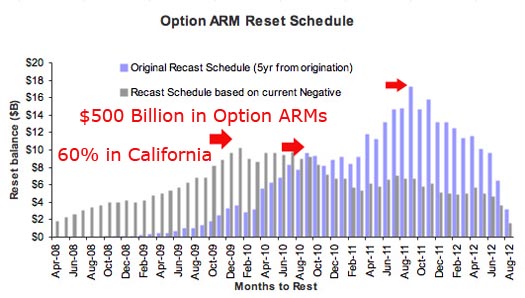
Also, if you've enjoyed partial bank nationalization hold on to your hats because more fun is on the way - Option Arm recasts - remember not to confuse recasts and resets, I always do. Basically one comes before the other, and the second one is more important, because that is when you _have_ to pay more per month.
With 80% of these Option Arm people making the minimum payment, you can expect 80% to foreclose or short sell. Housing prices fall even further. But don't worry 60% of Option Arms are in California. There is no way we are out of this crisis.
The real economy will continue to decline, and we'll be in a recession -officially- because we are certainly in one now.
While the above is pretty incoherant (from cars to Option Arms) it displays my basic pessimism about the economy and public policy - if Option Arms can happen, there is no God.
But remember to always look on the Always Look on Bright Side of Life.
-Duff
http://www.youtube.com/watch?v=daBx_PBrvSE
Always a classic, and very pertinent now.
A little history, Chrysler got a 1.5 billion dollar loan from the Gub'ment (Mark Twain version sp?) to avoid bankruptcy. As of the bailout plan, GM, Ford, Chrysler got 25 billion dollars I believe in a similar deal. I know it sounds bad, but I have little hope for the US of A's car companies. Chrysler did pay back there old loan (early even), depending on long-term energy prices (demand and supply see-sawing against each other) and the affect of credit (betting on future growth). I'm thinking that won't quite be the case again.
Also, if you've enjoyed partial bank nationalization hold on to your hats because more fun is on the way - Option Arm recasts - remember not to confuse recasts and resets, I always do. Basically one comes before the other, and the second one is more important, because that is when you _have_ to pay more per month.
With 80% of these Option Arm people making the minimum payment, you can expect 80% to foreclose or short sell. Housing prices fall even further. But don't worry 60% of Option Arms are in California. There is no way we are out of this crisis.
The real economy will continue to decline, and we'll be in a recession -officially- because we are certainly in one now.
While the above is pretty incoherant (from cars to Option Arms) it displays my basic pessimism about the economy and public policy - if Option Arms can happen, there is no God.
But remember to always look on the Always Look on Bright Side of Life.
-Duff
Friday, October 24, 2008
With the new GEM stuff, I've got double the FPS in UT2004
//ut2004 benchmark results:
T2004 Build UT2004_Build_[2004-09-21_19.13]
x86-64 Linux
Unknown processor @ 2396 MHz
Mesa DRI Intel(R) 965GM GEM 20080716
dm-rankin?spectatoronly=1?numbots=12?quickstart=1?attractcam=1 -benchmark -seconds=77 -exitafterdemo -exec=/opt/ut2004-demo/Benchmark/Stuff/botmatchexec.txt
4.439383 / 24.573044 / 76.100990 fps rand[1886997259]
Score = 24.603319
//end results
24 FPS, while not super awesome, is playable, barely.
Although now celestia is running dog slow...
//ut2004 benchmark results:
T2004 Build UT2004_Build_[2004-09-21_19.13]
x86-64 Linux
Unknown processor @ 2396 MHz
Mesa DRI Intel(R) 965GM GEM 20080716
dm-rankin?spectatoronly=1?numbots=12?quickstart=1?attractcam=1 -benchmark -seconds=77 -exitafterdemo -exec=/opt/ut2004-demo/Benchmark/Stuff/botmatchexec.txt
4.439383 / 24.573044 / 76.100990 fps rand[1886997259]
Score = 24.603319
//end results
24 FPS, while not super awesome, is playable, barely.
Although now celestia is running dog slow...
Sunday, August 03, 2008
e17's expedite:
$ expedite -e gl
Failed to initialize TTM buffer manager. Falling back to classic.
76.78 , Image Blend Unscaled
67.44 , Image Blend Solid Unscaled
46.03 , Image Blend Nearest Scaled
46.22 , Image Blend Nearest Solid Scaled
46.39 , Image Blend Smooth Scaled
46.17 , Image Blend Smooth Solid Scaled
42.49 , Image Blend Border
44.79 , Image Blend Solid Border
43.46 , Image Blend Border Recolor
322.29 , Image Quality Scale
96.92 , Image Data ARGB
55.42 , Image Data ARGB Alpha
306.71 , Image Data YCbCr 601 Pointer List
338.09 , Image Data YCbCr 601 Pointer List Wide Stride
128.40 , Image Crossfade
98.84 , Text Basic
16.09 , Text Styles
14.92 , Text Styles Different Strings
72.97 , Text Change
88.36 , Textblock Basic
50.57 , Textblock Intl
60.21 , Rect Blend
62.39 , Rect Solid
527.56 , Rect Blend Few
624.59 , Rect Solid Few
247.03 , Image Blend Occlude 1 Few
226.17 , Image Blend Occlude 2 Few
314.52 , Image Blend Occlude 3 Few
85.65 , Image Blend Occlude 1
77.33 , Image Blend Occlude 2
89.15 , Image Blend Occlude 3
37.04 , Image Blend Occlude 1 Many
34.36 , Image Blend Occlude 2 Many
37.31 , Image Blend Occlude 3 Many
7.07 , Image Blend Occlude 1 Very Many
6.43 , Image Blend Occlude 2 Very Many
7.12 , Image Blend Occlude 3 Very Many
61.70 , Polygon Blend
119.87 , EVAS SPEED
In gentoo land that's using:
# pmerge -p mesa libdrm
* Resolving...
[ebuild R ] media-libs/mesa-7.1_rc3 USE="-debug -doc -motif (-nptl) -pic -xcb" VIDEO_CARDS="i810 -mach64 -mga -none -r128 -radeon -s3virge -savage -sis -sunffb -tdfx -trident -via"
[ebuild R ] x11-libs/libdrm-2.3.1 USE="-debug"
Not sure if these benchmarks are good or bad, but I'm going to update libdrm and see if that makes a difference.
$ expedite -e gl
Failed to initialize TTM buffer manager. Falling back to classic.
76.78 , Image Blend Unscaled
67.44 , Image Blend Solid Unscaled
46.03 , Image Blend Nearest Scaled
46.22 , Image Blend Nearest Solid Scaled
46.39 , Image Blend Smooth Scaled
46.17 , Image Blend Smooth Solid Scaled
42.49 , Image Blend Border
44.79 , Image Blend Solid Border
43.46 , Image Blend Border Recolor
322.29 , Image Quality Scale
96.92 , Image Data ARGB
55.42 , Image Data ARGB Alpha
306.71 , Image Data YCbCr 601 Pointer List
338.09 , Image Data YCbCr 601 Pointer List Wide Stride
128.40 , Image Crossfade
98.84 , Text Basic
16.09 , Text Styles
14.92 , Text Styles Different Strings
72.97 , Text Change
88.36 , Textblock Basic
50.57 , Textblock Intl
60.21 , Rect Blend
62.39 , Rect Solid
527.56 , Rect Blend Few
624.59 , Rect Solid Few
247.03 , Image Blend Occlude 1 Few
226.17 , Image Blend Occlude 2 Few
314.52 , Image Blend Occlude 3 Few
85.65 , Image Blend Occlude 1
77.33 , Image Blend Occlude 2
89.15 , Image Blend Occlude 3
37.04 , Image Blend Occlude 1 Many
34.36 , Image Blend Occlude 2 Many
37.31 , Image Blend Occlude 3 Many
7.07 , Image Blend Occlude 1 Very Many
6.43 , Image Blend Occlude 2 Very Many
7.12 , Image Blend Occlude 3 Very Many
61.70 , Polygon Blend
119.87 , EVAS SPEED
In gentoo land that's using:
# pmerge -p mesa libdrm
* Resolving...
[ebuild R ] media-libs/mesa-7.1_rc3 USE="-debug -doc -motif (-nptl) -pic -xcb" VIDEO_CARDS="i810 -mach64 -mga -none -r128 -radeon -s3virge -savage -sis -sunffb -tdfx -trident -via"
[ebuild R ] x11-libs/libdrm-2.3.1 USE="-debug"
Not sure if these benchmarks are good or bad, but I'm going to update libdrm and see if that makes a difference.
Subscribe to:
Posts (Atom)